

Between Sundays
“Greet Andronicus and Junia, my relatives who were in prison with me; they are prominent among the apostles, and they were in Christ before I was.”
~ Romans 16:7
This week, the Southern Baptist Convention voted to advance a formal ban on women serving as pastors. The measure passed by roughly a three to one margin, and while it still requires a second vote next year to be written into their constitution, the message was unmistakable. In the nation’s largest Protestant denomination, the official position is that the pulpit belongs to men alone.Let me be clear and fair right away, because accuracy matters to me as both a pastor and a teacher. Not all Baptists are Southern Baptists. The Baptist tradition is wide and varied, and there are many Baptist churches, including many right here in our area, who ordain women, celebrate women’s leadership, and are grieved by this vote. So, I am not painting with a broad brush. I am naming a specific decision by a specific body.
But I would be failing you as your pastor if I did not say plainly that this decision troubles me, and not only for what it means inside one denomination. It troubles me because it is symptomatic of something larger and more pervasive in our culture right now, a steady deafening of the female voice, and along with it, the voices of so many others pushed to the margins of our common life together. When we tell half the body of Christ that God may have called them, but the church will not hear them, we are not making a decision or a vote. We are making a theological claim about whose voice carries the gospel. And I believe that claim is wrong.
We need to wake up.
Here is where the history teacher in me cannot stay quiet. So much of how we read scripture has been shaped by the hands that translated it, and those hands were not neutral. Consider Junia, whom Paul greets in Romans 16 and calls prominent among the apostles. A woman. An apostle. Named by Paul himself with honor. And yet for centuries, translators and scribes, unable or unwilling to accept that Paul would call a woman an apostle, quietly changed her name to a masculine form, Junias, a name that does not actually appear anywhere in the ancient world. Scholars like Dr. Carla Works, a New Testament scholar, as of 2023, Dean to Wesley Theological Seminary here in D.C. and one of my favorite professors during my time there, have helped recover Junia and others like her, reminding us that women were leaders in the earliest church, and that their erasure was a later human edit, not an original divine intention.
I find myself reminding bible study groups and students all the time, the King James Version is a translation, completed in 1611, and for all its influence it is a deeply patriarchal one, shaped by the assumptions and politics of the men who produced it. King James himself, for that matter, was not one of the twelve disciples, though you would be surprised how many people seem to think he was. When we mistake a particular translation, or a particular era’s reading of it, for the unfiltered voice of God, we hand enormous power to the people who did the translating. And sometimes what they handed down to us quietly wrote women out of the story God had written them into.
This is not a partisan matter, and I want to resist every effort to make it one. It is older than any of our current political divisions, and it cuts across all of them. It is about whether we are willing to read scripture with our eyes open, to ask who has been silenced and why, and to listen to the voices the tradition tried to talk over. Sometimes in study, what I refer to as “the white on the page of black and white letters.”
I am grateful, deeply grateful, to serve in the United Methodist Church, which has affirmed and ordained women in ministry for seventy years now and continues to do so without apology. I do not take that for granted. Every time I step into our pulpit, I am standing in a place that some would say I have no business standing in, and I am able to stand there because this church decided, generations ago, that God’s call does not check for gender first. That is a gift. It is also a responsibility, to keep the door open for every woman, every young person, every marginalized voice still waiting to be told that yes, God can speak through you too.
So, this week, my invitation is simply to pay attention. To notice whose voices are amplified and whose are quiet, in our world, in our churches, and even in our own assumptions. And to ask whether we are listening the way Jesus listened, which is to say, especially to the ones everyone else had stopped hearing.
Junia is still prominent among the apostles. It just took us a while to hear her name again. Let’s not make that mistake with anyone else.
Until Sunday, and all the days between,
Dr. Hutton
If you are interested in more from Dr. Works I highly recommend the following podcast and if you don’t do podcasts, there’s a transcript too.
https://www.churchleadership.com/podcast/episode-37-learning-about-leadership-from-women-in-the-bible-featuring-carla-works/
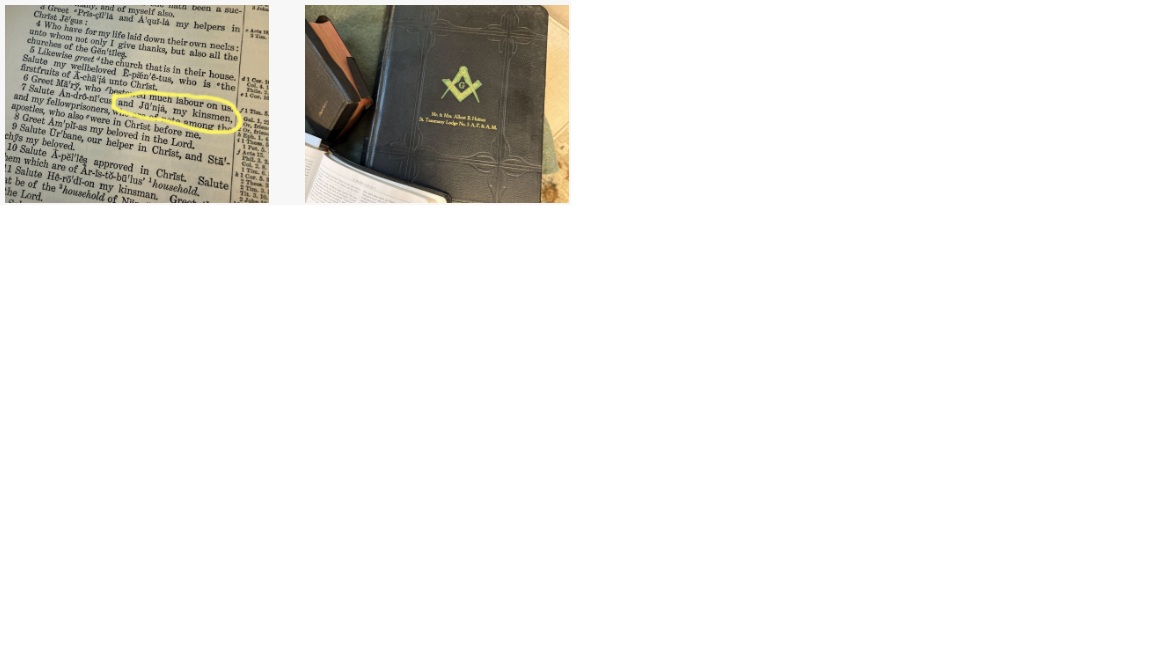
Today’s Greek Lesson – Because words matter
The word Paul uses for Andronicus and Junia is συγγενής (syn-geh-NACE). It comes from two pieces, syn, “together,” and gen, the root for birth and family. You can hear it in our words gene, genus, generation. Literally, it means “of the same blood.” Kin.
Watch that one word travel into English:
- King James (1611): “kinsmen.” Notice the reach for the masculine, in a verse greeting a woman.
- Newer translations: “relatives,” closer to the literal sense.
- NRSVUE, the version nearest to the original Greek and most recommended for seminarians today: “my fellow Israelites.”
Paul was not naming blood relatives. He means my people, my kin in the deeper sense. The word is about belonging, not biology. And every step toward accuracy turns out to be a step toward seeing Junia more clearly.
Pictured above: my grandfather’s Masonic Bible – a King James translation from 1949 – And why I find value in collecting Bibles. 🙂